
Showing posts with label The Running Grave. Show all posts
Showing posts with label The Running Grave. Show all posts
Wednesday, October 7, 2026
Goblet of Fire-Running Grave Links, Part 3. Arrivals and early days at Chapman Farm and Hogwarts.
Monday, October 5, 2026
Goblet of Fire-Running Grave links, Part 2. Slim pickings at the World Cup and at Rupert Court.

Saturday, October 3, 2026
Goblet of Fire-The Running Grave Links, Part 1: A look at perspective and content in the first three chapters.

Happily, as I started my look at The Goblet of Fire and The Running Grave, I saw that this pairing is no exception. The most notable similarity is that both books start with a somewhat unusual point of view, one of someone other than the protagonists. Goblet of Fire sets up the main storyline by providing first a newsreel-like history of the Riddle family murder in Little Hangleton, followed by the suspicion cast on Frank Bryce and his subsequent discovery of Wormtail and Voldemort hiding out in the old Riddle house. Interestingly, though the end of the scene cuts into Harry Potter's scar-tingling nightmare that he presumably sees through the mental link with the Dark Lord, the narrative presented to the readers is from the perspective of Frank Bryce, including events and thoughts of which Voldemort was unaware. Chapters from the perspective of someone other than Harry are very rare in the Potter series, occurring only in the first chapters of books 1, 4 and 7 and in the first two chapters of book 6.

Both of these opening, alternate-perspective segments end with a relatively abrupt death. Frank Bryce, like the Riddles of fifty years prior, is Avada Kedavra'ed by Voldemort, and therefore "is dead before he reached the floor." Sally Edensor succumbs fairly quickly to her brain tumor, even though "the doctors thought she had longer." Although neither of these deaths is the major murder our heroes will eventually solve in these books, the story of both deaths is used to set up the major storyline.
Saturday, September 7, 2024
Reading Along with Prudence, Part 7: Real-Life Flora Brewsters

J.: a former Scientologist. Despite the fact that he reached the near-highest levels of the organization, he never developed the supernatural powers he was promised. The UHC people could probably relate to that. He was also subjected to defamation, including child abuse accusations, and decades of lawsuits.
R.: Human trafficking victim. Forced sex with strangers and mental manipulation, with a behaviors controlled by rewards and punishments.
M: Islamic terrorism cult: Members forced to cut all family ties, divorcing spouses and surrendering children for adoption.
J: Shasta Abbey, a Zen Buddhism cult. Told he would be jailed, committed to a psychiatric hospital or go broke if he left the community. Members were subjected to humiliating verbal attacks and sudden demotions.
E: A former follower of Lyndon LaRouche. LaRouche, though a political rather than a religious leader, is described as narcissistic, and is a wealthy leader who proclaims himself to be at war with the world and who promotes his own doctrine above all.
H: A male supermodel who was a member of the New Age cult Eternal Values, a group that believed that a geological apocalypse is eminent and that only their leader's contact with space aliens will save a remnant of humanity. This reminds us a bit of Shauna's odd beliefs about Wace. H's head was shaved to humiliate him, and he, like UHC members, was forced into slave labor.

G: Member of a group who focused on chanting a particular Japanese phrase for multiple hours per day, in the belief that wishes will be granted as a result. G. experienced a "high" from chanting, not unlike Robin. Conformity with the group doctrine was stressed, and G. and his wife, who were eventually expelled, were convinced terrible things would happen to them outside the group, if they stopped chanting. This group also had some notable celebrity members.
R: A young man born into the Jehovah's Witnesses and felt his upbringing matched many of the cultic practices described in Hassan's book, including denigrating and forbidding contact with former members. Hassan credits R. and others born into cults who manage to leave with special courage, since they face losing all of their family and friends. TRG readers saw this in people like Linn Doherty and Kevin Pirbright.
G: A woman who was caught up in a transcendental meditation cult. Like in the UHC, members were subjected to hours of meditation and questionable herbal medications.
L and L: Two other people raised in the Jehovah's Witnesses who where shunned by family after leaving.
T: A leader in his LDS church, who had doubts about his faith despite his public practice. Like those in the UHC, Tom reported being taught that everything outside the faith was evil and "of the Devil." T's story is a lot like Will's, in that he gradually began to question the doctrine he had believed for so long.
Hassan reiterates high praise for ex-cult members who have gone public with their stories, both to warn others about cult dangers and to help reduce the stigma associated with having been victimized by such groups. As H. says, "We should be proud and hold our heads high. Coming forward and telling out stories is one of the greatest gifts we can give to others."
-----------------------------------------------
As long-time readers know, I have never attempted to monetize this blog, but I do occasionally post charitable links, and ask readers to consider a small donation to these causes. My daughter and I are competing in the Great Valley Baking Championship, a fundraiser for Adagio House, a non-center offering counseling and other services to individuals with special needs and their families. Anyone who would like to support our team, the FDBS Baking House-Elves, can donate here.

Saturday, April 27, 2024
Reading Along with Prudence, Part 6: The Psychological Blueprint of the UHC.

Hassan identifies ten common denominators shared by destructive cults. As TRG readers will quickly note, these form an apparent blueprint for the creation of the UHC.
Sunday, April 21, 2024
Reading along with Prudence, Part 5A: Constructing a new cult identity, and how Robin tapped into Will's old one.

- Unfreezing: Breaking a person down.
- Changing: Indoctrination.
- Refreezing: Building up and reinforcing a new identity.
The unfreezing part involves disrupting the person's sense of reality, using confusion and disorientation. This can happen physiologically through sleep deprivation and enforcing a nutrient-poor diet, as seen in the UHC. Another technique is repeatedly presenting confusing information, so as to induce a hypnotic trance. Robin certainly recognized this method, as she told Flora, "They force you to agree up's down and black's white. It's part of the way they control you."
Group situations are also prime times for creating unbalance.
Exercises, such as guided meditation, personal confessions, prayer sessions, vigorous calisthenics, and even group singing, can also aid in unfreezing, Typically, these activities start out quite innocuously, but gradually become more intense and directed. They are almost always conducted in a group. This enforces privacy deprivation and thwarts a person's need to be alone, think and reflect. At these stage of unfreezing, as people are weakening, most cults bombard them with the idea that they are seriously flawed. incompetent, mentally ill, or spiritually fallen... Some groups can be quite vicious on their attacks at this stage.
The small-group lectures and chanting sessions at the UHC eventually turned into the abusive confrontations of Revelation.
Saturday, April 20, 2024
Reading along with Prudence, Part 5: Who is the only genuinely brainwashed person at Chapman Farm? The answer will surprise you.

Most ominously for Robin in her undercover mission, Hassan says:
Even if the person gets along with deliberate play-acting at first, the act eventually becomes real. They take on a totalistic ideology, that, when internalized, supersedes their prior belief system.
Hassan also speaks of children born into such organizations:
Children unfortunate enough to be born to members of a destructive cult are deprived of a healthy psychological environment in which to mature optimally. That said, children are remarkably resilient, and I have met many who described never completely buying into the crazy beliefs and practices. Most ran away or found a way to escape before they became an adult. Yet, for others, it took decades to find the strength and the courage to be true to themselves.
Kevin Pirbright was probably the best example of such a resilient character in TRG, although we also see echoes of that trait in Linn Doherty, with her wish to run away with Qing and Emily Pirbright, who was ready to leave the group to be with her lover.

What is true brain-washing?
Hassan cautions that using the terms "mind control" and "brainwashing" synonymously is a mistake, although many do, including Strike and Robin in this book: for instance, when Robin calls the education of the cult children, "being brainwashed." Ironically, there is only one character who briefly can be considered "brainwashed" and that is Robin herself. How can that be? Find out after the jump.
Saturday, April 6, 2024
Reading along with Prudence, Part 4: A look at the UHC through the Lens of Modern Cult Practices.

If people want to believe Sun Myung Moon, or Charles Manson, or their dog is the messiah, that is their right. However, and this is the crucial point: people need to be protected from processes that make them believe Manson or Moon is the messiah... If deception, hypnosis or other mind-control techniques are being used to recruit and control followers, then peoples' rights are being infringed upon.

One technique, widely popular at that time, was the "hot seat," which was first used by the drug rehab cult, Synanon. A member of the group sat in the center of the circle, while other members confronted them with what they considered to be the person's shortcomings or problems. Needless to say, without the supervision of an experienced therapist, and sometimes even with it, such a technique opens up considerable possibilities of abuse.
Continued...
Tuesday, April 2, 2024
Reading Along with Prudence, Part 3: Entering and Exiting a Cult.

Only when Hassan was away at a Tarrytown estate and dependent of the group members for a ride back to Queens did he learn that the "retreat" was actually a three-day workshop run by the Unification Church. Having no transportation back to his university, he was forced to stay for three days of lectures on the "Divine Principle." It is easy to see why Henry Worthington-Fields was grateful he brought his own car to Chapman Farm.

Contined....
Saturday, March 30, 2024
Reading Along With Prudence, Part 2: An Introduction to Destructive Cults, and the basis of the UHC

Hassan also stresses the importance of educating the public about the dangers of cults that practice undue influence. This knowledge can serve as an "inoculation" against mind control; as he states, "People's resistance is higher when they are aware of the danger." Prudence echoes this exact idea when she recommends Hassan's book and warns Robin to be careful when going undercover: "Being able to identify their techniques will help you resist them." Indeed, when Prudence describes getting professional support with her ex-UHC patient from "an American therapist who's worked with a lot of cult survivors," it is not a stretch to imagine that she contacted Hassan himself.
When describing the "nightmare reality" of abusive cults, Hassan describes his clients as:
people who have been systematically lied to, physically abused, separated from their families and friends, and forced into servitude.

a world where thought police maintain complete control over people's mental and emotional lives, and where it is a crime to act or think independently, or even to fall in love.
Hassan maintains that modern day abusive cults resemble Orwell's dystopia:
In these groups, basic respect for the individual is secondary to the leader's whims and ideology. People are manipulated and coerced to think, feel and behave in a single "right" way. Individuals become totally dependent on the group and lose the ability to act or think on their own. They are typically exploited for the sake of the group's economic or political ends.
Those of us who spent four grueling months with Robin in Chapman Farm will recognize every one of those elements. I was reminded particularly of Becca Emily Pirbright and her forbidden "pure materialism" love affair. Despite knowing that the story of the Drowned Prophet was a lie, was unable to break away, even when the opportunity presented itself in Norwich.
Continued...
Friday, March 29, 2024
Reading Along with Prudence, Part 1: Hassan's Combating Cult Mind Control


Strike and Robin likely read the 2015 edition, although it is possible that Prudence gave them an earlier edition. I listened to the audiobook of the most recent edition, published in 2018 to commemorate the 40th anniversary of the Jonestown massacre. Readers can also access the original 1990 edition here.
So, without further ado, let's start the read-along with Prudence.
Tuesday, October 31, 2023
Two Delectable Halloween Treats: A Super-Spooky Essay by Beatrice Groves and a Ghostly Podcast by the Three Broomsticks.

Boo to you, dear readers, on All Hallow's Eve. This is a day important in the Harry Potter world, though, as I recall, it has only come up once in the Strike and Ellacott series. In Lethal White, Strike and Robin visit the Three Kings pub, site of Margot and Oonaugh's would-be meeting, and note the costumed drinkers, including, interestingly, a woman in a naughty nurse costume.


Whether you want to enjoy Strike, Harry or both, have a safe and spooktacular Halloween!

Monday, October 30, 2023
Water, water everywhere: Baptism, baths, rivers, rain and showers as unifying themes in The Running Grave.
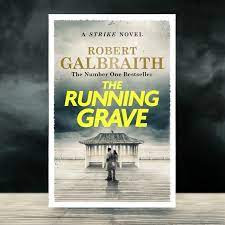
One of the many connections The Running Grave has with Troubled Blood is the theme of water. Troubled Blood, of course, centered around the real-life Cornish floods of 2014. A Running Grave has its share of rain, including one real-life storm, but more of its water comes in the form of baptismal imagery, both traditional and macabre. How does this unite both the book and StrikeandRobin into a coherent whole? Find out after the jump.
Tuesday, October 24, 2023
Notes on The Running Grave Re-listen Part II: What is Ted's Actual Diagnosis?
I'm continuing my post of random bits I noticed in my second listen through The Running Grave. As always, spoilers ahead.

Friday, October 20, 2023
Robin Ellacott and the Running Hallows: Potter Echoes in the Most Recent Strike Novel
I'm midway through my favorite two academic days of the year, the annual Chestnut Hill College Harry Potter Academic Conference. The organizers were kind enough to be flexible with the deadlines and let me submit an abstract on The Running Grave. Here is my recorded presentation. Enjoy! Spoilers for TRG.
Thursday, October 19, 2023
For The Running Grave Fans: Two Great Releases.
I'm going to be tied up with the Harry Potter Academic Conference for the next two days., but I wanted to share two resources for The Running Grave readers. Both links include spoilers, naturally.
First, Kurt Schreyer has a great new essay on epistemology in TRG published at the Strike and Ellacott files blog.
Second, there an interview with "Robert Galbraith" was released on Facebook today. It can be viewed here:
My talk, "Robin Ellacott and the Running Hallows" is tomorrow at 10:10. I'll post it here tomorrow.
Wednesday, October 18, 2023
The White Lady of the Shrieking Pits: Is a Ghost Haunting Chapman Farm?
Despite Cormoran Strike's firm "team rational" position, spectral spirits seem to haunt his detective novels. For evidence, see these other posts on Charlie Bristow of Cuckoo's Calling, Freddie Chiswell of Lethal White, and Margot Bamborough of Troubed Blood. Is a similar ghost haunting Chapman Farm, without the aid of the Wace's smoke and mirrors? I am going to argue that there is a genuine ghost among the fake ones, one whose story could be considered a re-telling of a local Aylmerton ghost story, much like Jasper Chiswell's story is a re-telling of the Francis Rattenbury murder.
For background on Norfolk folklore, I recommend two excellent articles by Beatrice Groves (both written pre-TRG, so no spoilers): here and here. In particular, the story of the Shrieking Pits is most relevant.
Three miles from Cromer, five such pits are visible in Aylmerton in the wooded slopes close to the Gresham Cross, close to the pilgrims' path which heads towards the holy shrines at Walsingham– these are known locally as the Shrieking Pits.
Folklore tells of a ghostly figure wearing white that haunts the pits, weeping and wailing as she walks between each pit, endlessly searching the depressions in the ground, looking for her baby. The child was killed by her husband who was convinced the baby wasn't his and, after he had buried the infant in the pit west of Aylmerton church, he went back and killed his wife.
Which UHC resident connects to the White Lady? Find out after the jump. Spoiler warning.

Monday, October 16, 2023
What's in a Name?. Meaningful Names of Key Families in The Running Grave. Part I: Beware the Crowthers.
Ever since Remus Lupin turned out to be a werewolf and Sirius Black a disguised big black dog. we've been trained to look for cratylic names (or sometimes, ironically anti-cratylic, like Fluffy for the savage dog and Fang for the gentle one)in the works of JKR/RG. The Running Grave was no exception. I have been making notes on names as I blogged my way through the initial read, but I wanted to compile a new list, now that we've finished the book. There are an unusually high number of family groups in The Running Grave, so I'm going to start with the major families in the story. Spoilers ho!

Sunday, October 15, 2023
Notes on The Running Grave Re-listen Part I
For me, the best part of a Cormoran Strike book is not the first reading, but the re-reads, knowing full spoilers. and seeing the hints you missed and the red herrings you fell for. Here's some thoughts.
Spoilers below.

Friday, October 13, 2023
Divergent as YA Wednesday Weekend Pick, The Harry Potter Academic Conference and Author Chat on The Running Grave
I'm still hard at work on my cratylic names post, which is taking a while, given the number of names in The Running Grave, but I wanted to share a few bits of news that I am excited about. First, although The Running Grave and other Strike posts have understandably dominated here for the last few weeks, I never intended this blog to center exclusively on Strike, or Strike/Harry Potter connections. My first love is young adult literature and, while my scholarship into psychological themes in YA literature was triggered by Harry Potter, my interests spread well beyond that series.

I was delighted to see on Facebook that Veronica Roth's Divergent was the featured weekend pick on Dr. Bickmore's YA Wednesday page. If you teach YA literature or, like me, simply enjoy reading it, this page is well worth following. For Divergent enthusiasts out there, here are some links to some of my earlier posts on that series, as well as to some talks and podcasts I have done on the topic.
Two key posts on the Divergent Factions and their connections to Five Factor Personality theory. Part I and Part II.
Those posts became my first Hogpro material ever cited in in a scientific conference paper. That research was eventually published in a peer-reviewed journal.
I wrote about a few other Divergent-based topics, too:
The significance of the zip-lining adventure,
The movie screening with the Mary Baldwin psychology department.
Why Allegiant might have worked better with epigenetic rather than genetic experimentation.
Finally, for those interested in Divergent-Harry Potter connections, I will point you to:
My Mugglenet Academia appearance: Tris Transfigured!
And
My Chestnut Hill presentation on Tris Prior and Hermione Granger as twin personalities.
Speaking of the Harry Potter Academic Conference, we are only a week away! It is all online this year and, though I will miss seeing all my favorite Potter buddies in person, it is a great opportunity for anyone to attend, without the expense of travel. For $15, you can get two days of amazing Potter and Rowling scholarship. My own talk, which, I believe, will be the first-ever academic presentation on The Running Grave, is Friday morning.

Finally, speaking of TRG, there will be a Facebook discussion with the author on Thursday, October 19th, at 7 PM BST, (2 PM EST, for those of us in the US). I may well be on the road from Tennessee to Virginia then, but maybe I can time lunch at a fast food joint with Wifi and tune in then,
That's it for now; back to the name game.
Subscribe to:
Posts (Atom)